- Subscribe to RSS Feed
- Mark Topic as New
- Mark Topic as Read
- Float this Topic for Current User
- Bookmark
- Subscribe
- Mute
- Printer Friendly Page
Labview+arduino+Water Flow sensor help!

 KronoSSharK
05-13-2014 09:02 PM
- Mark as New
- Bookmark
- Subscribe
- Mute
- Subscribe to RSS Feed
- Permalink
- Report to a Moderator
hola a todos en NI, he decidido crear una pequeña aplicacion para saber cuanto flujo de agua pasa por una tuberia.
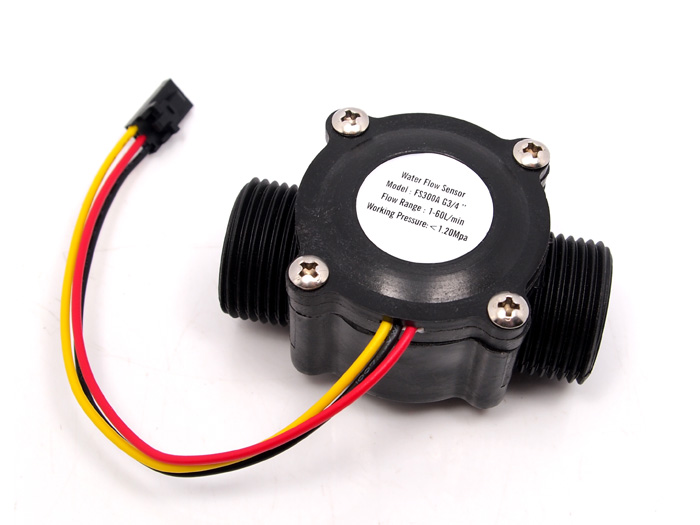
este es el sensor que intento usar, la respuesta es en pulsos, con el sketch desde el arduino logro optener los datos necesarios, pero la idea es usarlo desde labview, no he podido adquirir datos del sensor, no se cual es la herramienta correcta para hallar la frecuencia.
I need help, which tool can calculate the frequency of this sensor. thanks
 jennny
05-13-2014 09:58 PM
- Mark as New
- Bookmark
- Subscribe
- Mute
- Subscribe to RSS Feed
- Permalink
- Report to a Moderator
hola!
que chulo! yo queria hacer algo parecido, ese sensor tiene el calbe de salida amirillo tipuico de pwm¿? tienes datashet? dime algo aremos juntos ... jejej
un saludo
05-13-2014 10:12 PM
- Mark as New
- Bookmark
- Subscribe
- Mute
- Subscribe to RSS Feed
- Permalink
- Report to a Moderator
hola jenny, pues el sensor da respuesta en pulsos y dependiendo de la frecuencia asi sera el caudal, por ejemplo, si la frecuencia es de 60 Hz el caudal es de 10 litros/Min, el problema es que no se como calcular dicha frecuencia en labview.

 Nathan_B.
05-14-2014 04:06 AM
- Mark as New
- Bookmark
- Subscribe
- Mute
- Subscribe to RSS Feed
- Permalink
- Report to a Moderator
The only way that I could think of to get close to getting an accurate value is to hook it to an analog pin and do a finite acquisition and then process that data to get the frequency.
Also, you should consider using LINX istead of LIFA (which is no longer offically supported).
 hammad92
09-04-2014 08:29 AM
- Mark as New
- Bookmark
- Subscribe
- Mute
- Subscribe to RSS Feed
- Permalink
- Report to a Moderator
hi tested this pin hooking up to an analog pin but doesnt work.... connecting to a digital pin and reading it can read the high and low signal values 0 and 1 but is there any possible way to read the frequency via the digital pin and using the interupts
the arduino code for the above sensor is provided in the below link
http://www.seeedstudio.com/forum/viewtopic.php?f=4&t=989&p=3632
 hrh1818
09-04-2014 02:08 PM
- Mark as New
- Bookmark
- Subscribe
- Mute
- Subscribe to RSS Feed
- Permalink
- Report to a Moderator
Your question
"is there any possible way to read the frequency via the digital pin and using the interupts"
The present version of LIFA does not have the capability measure frequency or to use interrupts. If you need to measure frequency you can either modify LIFA or use a non LIFA approach. With a non LIFA approach you would use Labviews serial write and read capability and the Arduino code you provided a link to.
hrh1818
hammad92
09-04-2014 05:40 PM
- Mark as New
- Bookmark
- Subscribe
- Mute
- Subscribe to RSS Feed
- Permalink
- Report to a Moderator
how to modify the lifa i mean what exactly to be modified on the because im not so familiar with lifa
hammad92
09-04-2014 06:56 PM
- Mark as New
- Bookmark
- Subscribe
- Mute
- Subscribe to RSS Feed
- Permalink
- Report to a Moderator
can some one give me a guide on how to do this via lifa
Nathan_B.
09-04-2014 08:51 PM
- Mark as New
- Bookmark
- Subscribe
- Mute
- Subscribe to RSS Feed
- Permalink
- Report to a Moderator
To do it with LIFA intact, you might be able to just put that code in LIFA_Base.ino as long as you remove the serial communication and change the timing from a delay to a timestamp based timing. Then, you simply make a LIFA function (look at any exisitng function to see how to make one) that reports back the information that you want (stored in global variables).
hammad92
09-04-2014 11:41 PM
- Mark as New
- Bookmark
- Subscribe
- Mute
- Subscribe to RSS Feed
- Permalink
- Report to a Moderator
could you show me an example.. im not familiar on how the lifa firmware is coded so unaware on how to edit the lifa base to make this sensor work
