- Subscribe to RSS Feed
- Mark Topic as New
- Mark Topic as Read
- Float this Topic for Current User
- Bookmark
- Subscribe
- Mute
- Printer Friendly Page
- « Previous
-
- 1
- 2
- Next »
How to convert decimal to binary in Labview

 SteveChandler
02-05-2011 02:54 PM - edited 02-05-2011 02:56 PM
- Mark as New
- Bookmark
- Subscribe
- Mute
- Subscribe to RSS Feed
- Permalink
- Report to a Moderator
Edit: Looks like Dennis beat me to it 
You realize you are replying to a five and a half year old thread?
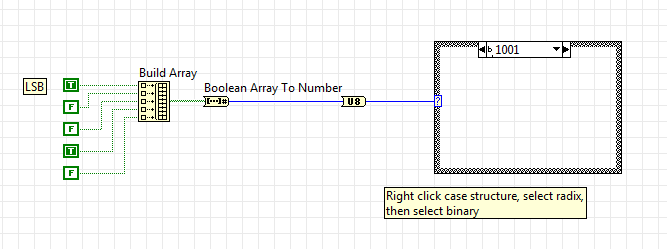
But anyway are you talking about somehow wiring five booleans to the selector and typing something like '10010' into the case?
LabVIEW 2012

 Daniel_H
02-05-2011 02:56 PM - edited 02-05-2011 02:58 PM
- Mark as New
- Bookmark
- Subscribe
- Mute
- Subscribe to RSS Feed
- Permalink
- Report to a Moderator
I know the thread is old, but it was the first thing that showed up in google, and my problem was the same.
Thank you very much for the answer.
actualy, it's 5 digital sensors connected to my cRIO, I need different senarios for each combination.
SteveChandler
02-05-2011 02:59 PM
- Mark as New
- Bookmark
- Subscribe
- Mute
- Subscribe to RSS Feed
- Permalink
- Report to a Moderator
Hey not a problem replying to an old thread! I didn't mean to imply otherwise and you are doing something that a lot of people do not do. You are researching before asking. Kudos for that!. I was just wondering if you saw the date
LabVIEW 2012

 slbLV
slbLV
04-03-2014 12:50 PM - edited 04-03-2014 12:53 PM
- Mark as New
- Bookmark
- Subscribe
- Mute
- Subscribe to RSS Feed
- Permalink
- Report to a Moderator
tbob;
".. any decimal number to a binary string .." [ UNumberToBinaryString.vi ]
Very useful ... just what I needed !!
Thanks

 altenbach

04-03-2014 02:50 PM - edited 04-03-2014 02:50 PM
- Mark as New
- Bookmark
- Subscribe
- Mute
- Subscribe to RSS Feed
- Permalink
- Report to a Moderator
@slbLV wrote:
tbob;
".. any decimal number to a binary string .." [ UNumberToBinaryString.vi ]
Very useful ... just what I needed !!
This thread seems a bit outdated, but here are two alternative that do exactly the same, but with less code. (look ma, no loops!)
Of course the correct way would be to create a polymorpic VI that adapts to the input type automatically. When creating the polymorphic instances, you might as well just use a diagram constant with the right format for each type.


 avinashchowdary
02-20-2019 05:05 AM
- Mark as New
- Bookmark
- Subscribe
- Mute
- Subscribe to RSS Feed
- Permalink
- Report to a Moderator
decimal to binary

 GerdW
GerdW
02-20-2019 05:51 AM - edited 02-20-2019 05:51 AM
- Mark as New
- Bookmark
- Subscribe
- Mute
- Subscribe to RSS Feed
- Permalink
- Report to a Moderator
Hi avinash,
why do you think your VI will help here?
See that small addition I made to your VI:
I just use FormatIntoString to get the very same result as your whole mess of number to boolean array and string conversion…
GerdW
using LV2016/2019/2021 on Win10/11+cRIO, TestStand2016/2019
- « Previous
-
- 1
- 2
- Next »
